Musings on healthcare IT, FHIR, EHR systems, and digital health innovation

🔥 FHIR in the hole!
Back to posts

Building a Greenbergolem

Original on LinkedIn
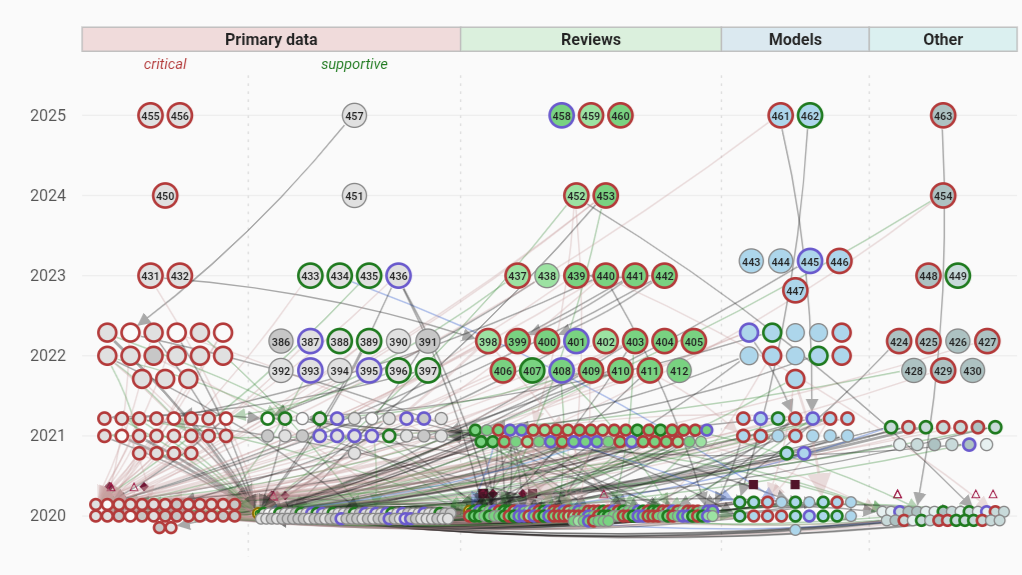
Isaac Kohane posted a challenge on April 16: build a citation-distortion network like Steven Greenberg’s 2009 BMJ figure, but AI-driven and reproducible for any claim. “There is a lot of AI work in this area but none to my knowledge could reproduce the figure below. Please prove me wrong. #citationNetworks”

Greenbergolem is my attempt with Claude Opus 4.7. I built this in 3-4 hours of my time, creating a pipeline that audits any scientific claim whose literature is reachable in open-access full text. Starting example: “Hydroxychloroquine improves clinical outcomes in patients with COVID-19” — this runs in about 12 hours of wall-clock subagent compute (Claude Code managing ~10 parallel copilot subagents). Interactive output at joshuamandel.com/greenbergolem (or read on for derails and structured output).

What Greenberg did

Greenberg manually traced 242 papers on β-amyloid in inclusion body myositis. For each paper he classified the intrinsic stance, read the sentences around every citation, typed each citation by rhetorical role, and surfaced a decade of citation-driven authority around a claim the primary data didn’t support: narrative reviews amplifying supportive work, critical findings going uncited, preliminary signals hardening into stated fact.

The annotation was the work. Zak’s challenge is whether a language model can do that annotation reliably enough to be worth reading.

The pipeline

Nine tasks in sequence:

research → 
corpus-build → 
paper-profile → 
occurrence-extract →
paper-judge → 
subclaim-label → 
edge-aggregate → 
graph-analyze → 
render

Four steps call LLM subagents (research, paper-profile, paper-judge, subclaim-label). The rest are mechanical — PubMed pagination, JATS parsing, citation-marker extraction, edge aggregation, HITS authority scoring, metric computation, SVG layout.

The conceptual split that makes it reusable is four-tier:

  • Epistemic primitives (role, stance, relevance enums) — universal rhetorical vocabulary, baked in.
  • Canonical catalogs — evidence-class taxonomy (rct, observational-clinical, meta-analysis, narrative-review, mechanistic-surrogate, …) and citation-invention taxonomy (dead-end, transmutation, diversion, back-door, retraction-blindness). Shipped as shared data; “catalog”: “biomed” gets you all of it.
  • Metric templates — within-group-supportive-share, authority-top-k concentration, role-ratio-complement, invention-rate. Pure functions in lib/metric-templates.ts. Unit-testable.
  • Claim-local config — ~30 lines of JSON per run: claim text, subclaim decomposition, PubMed include/exclude queries, year window, optional hints. The research subagent produces it.

For a new biomedical claim, the claim pack is the only thing authored.

Where judgment gets automated

paper-judge is the interesting step. One subagent call per citing paper, batched into chunks of ≤10 cited papers. The agent is handed the full body of the citing paper, the full body of each cited paper, and every pre-extracted citation sentence between them. It returns, per occurrence: on-claim or not, role, subclaim(s) engaged, optional invention-type tag, and short verbatim quotes from both the citing and cited passages.

That is a reasonably faithful mechanization of what Greenberg did by hand — reading two papers and deciding what the citation is actually doing. Two design choices made it work in practice:

  1. Full text on both sides. Abstract-only judgments confuse roles often enough to corrupt the graph. Europe PMC’s JATS endpoint covers most of the 2020–2025 HCQ literature in full.
  2. Evidence quotes as structural discipline. The output schema forces the subagent to produce a short quote from the citing sentence and a short quote from the cited paper before assigning a role. The rationale then has to reconcile those quotes with the label. It catches most hallucination at the source.response

The traditional AI pitch on literature review is search and summarization. The harder and more valuable part is adjudication — deciding what a specific citation is doing to a specific claim. That adjudication is what the pipeline mass-produces.

The HCQ run, by the numbers

For my automated run on the hydroxychloroquine claim:

  • 2,142 papers in the corpus; 1,168 from 2020 alone.
  • 17,616 citation occurrences across the graph.
  • 9,506 paper-to-paper edges — 4,595 supportive, 2,896 critical, 1,987 neutral, 28 mixed.
  • 781 edges flagged with at least one citation-invention pattern.
  • 16,237 individual occurrence judgments; 70% at confidence ≥ 0.9.

Wall-clock was dominated by paper-judge. Everything else is bounded by rate limits and I/O.

The output is a structured, annotated graph in JSON

Everything lands in bundle.json — papers, edges, occurrences, judgments, per-metric results, per-subclaim breakdowns. The bundled HTML viewer is one consumer of that file, mimicking Greenberg’s original visualization:
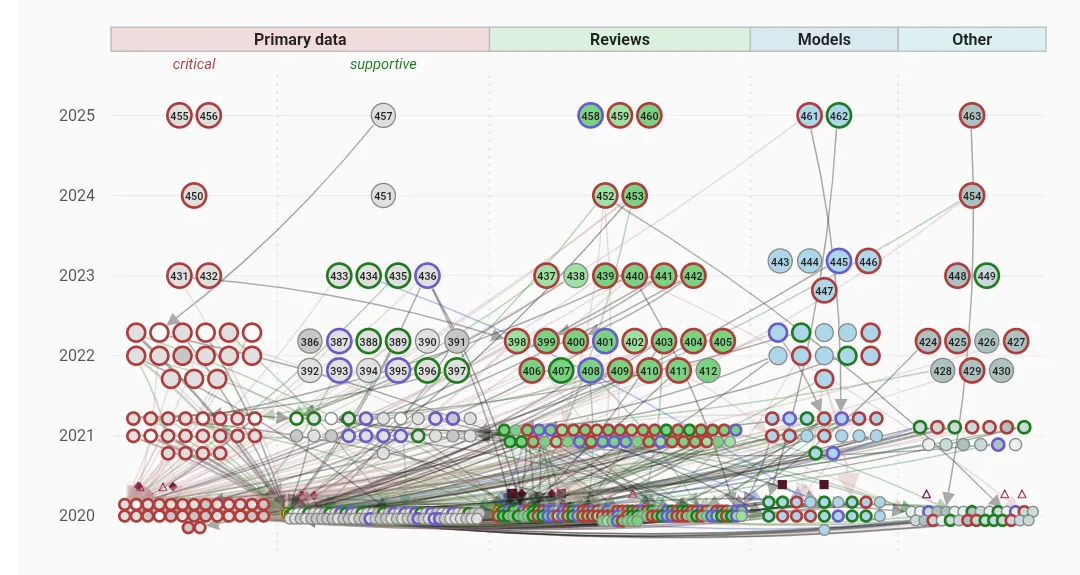
Article content

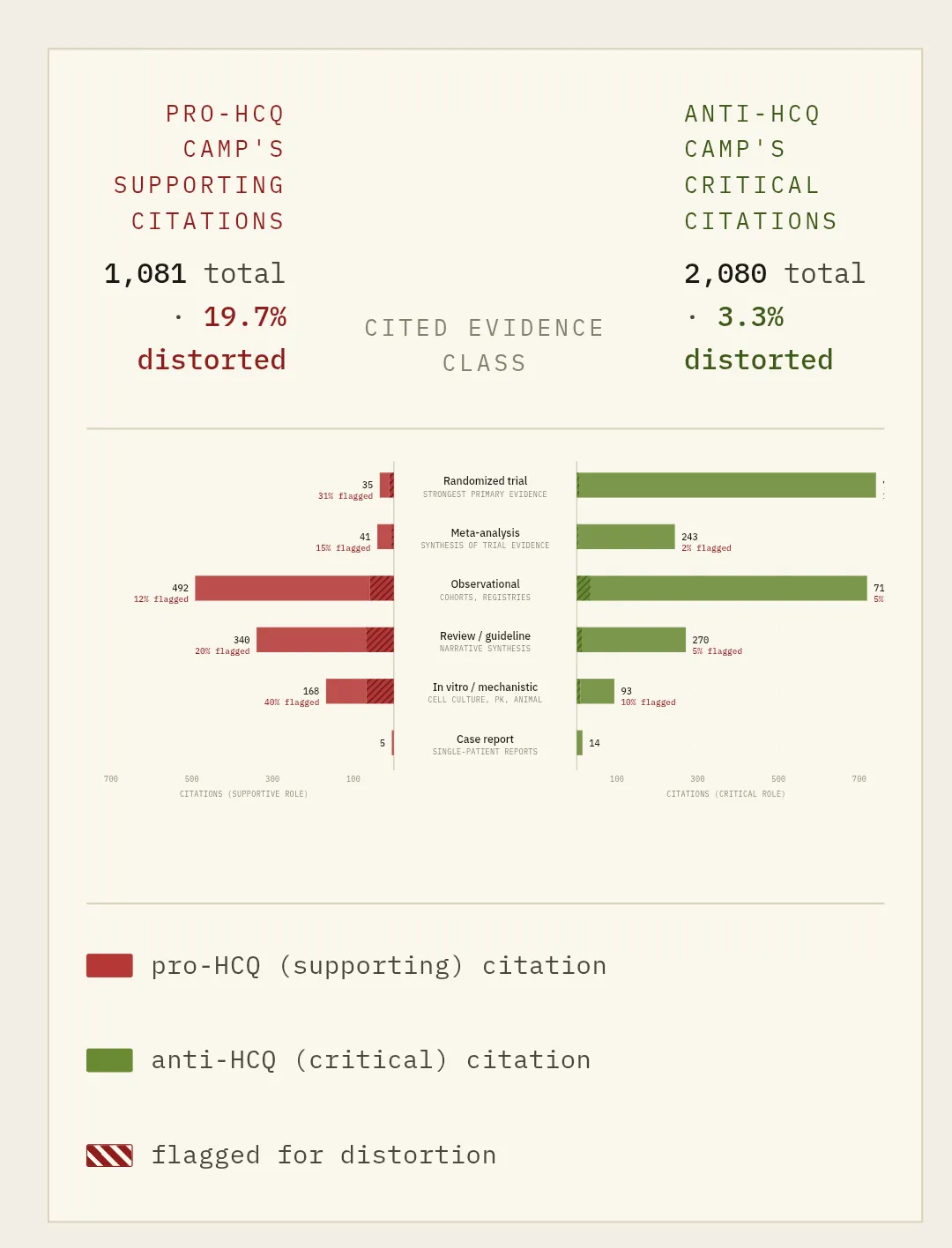
But with the structured data it’s easy to create more in depth analyses and views. For example I handed bundle.json to a fresh Claude session and asked for a visualization. A few prompts of back-and-forth produced this standalone audit report — a different take on the same data, with editorial framing the canned viewer doesn’t try to provide.
Article content

The analyst interface I care about isn’t a UI. It’s the bundle plus a chat window. Canned viewers lock you into whichever questions the UI was built to ask; ad-hoc analysis regenerates exactly the view the question needs.

What this isn’t

  • Not peer review. LLM judgments are uniform in method, not ground truth. 70–90% agreement with an expert coder still leaves hundreds of mislabeled edges per run.
  • Not a meta-analysis. Distortion patterns are structural signals, not effect sizes. The pipeline reports how citations behave, not whether the claim is true.
  • Not sound on paywalled literatures. It needs full text on both sides of every edge. Closed-access fields will underperform.
  • Not self-calibrated. The HCQ run has no held-out human annotation to compare against. Adding that is the highest-value next step.

Back to Zak

Greenberg’s 2009 figure was a multi-person, multi-month annotation project. Reproducing it on a new claim is now a weekend of model time plus a thirty-line claim pack. Cheerleading gratefully accepted.

Candidate claims on my list: the amyloid-cascade literature itself (Greenberg’s own domain, as a replication check), the serotonin hypothesis of depression, “statins reduce all-cause mortality in primary prevention.” Suggestions welcome.


Artifacts

Conversation on LinkedIn

28 comments · 119 reactionsReply on LinkedIn
  • Nikolai RyzhikovApr 18, 2026

    CTO @ Health Samurai; HealthDev | FHIR | PostgreSQL | Clojure | Agent Engineering. We are limited by time and imagination

    Awesome!

    2 reactions

  • Andrea D.Apr 18, 2026

    Co-Founder and Board President lightcollective.org

    So cool 👀

    1 reaction

  • Mark KramerApr 18, 2026

    Senior Principal Artificial Intelligence Engineer at MITRE Corporation

    You are the GOAT of problem analysis and rapid prototypes!

    9 reactions

  • Nikhil BhojwaniApr 18, 2026

    Managing Partner at Recon Strategy

    Impressive!

    1 reaction

  • Richard BramanApr 19, 2026

    Award Winning Innovation | Healthcare Standards & Interoperability (HL7 FHIR CDS Hooks) Business Process Automation (BPM +), AI & Agentic Systems

    Nice!

  • Ingrid WitherellApr 19, 2026

    Safety Researcher, Medical Writer, LLM mechanizer of the known, distiller of the unknown in tox, PK, PV, & RWE in IND, CSR, DSUR, SOP

    Is the word Golem in there for a reason?

    • Josh Mandel, MDAuthorApr 19, 2026

      I wanted an automaton that started with G so I could make a portmanteau with Greenberg...

      1 reaction

  • David BernickApr 19, 2026

    Finding and Securing all the data - and making it useful.

    I was talking to Kim Branson this week about the continual cross pollination in our field from like the same 20 people. And of course Zak and Josh were in that list. None of this is surprising. And the actual research is exactly what we were talking about this week.

    5 reactions

    • David BernickApr 19, 2026

      Finding and Securing all the data - and making it useful.

      David Bernick (and of course Wilbanks liked this post). We are the stack of infinite turtles.

      2 reactions

  • Alex MatsyukApr 19, 2026

    CEO & Co-Founder at Kozak Agency | Building reliable software systems

    Love this use case, literature analysis is massively underleveraged.

  • Dave deBronkartApr 20, 2026

    "e-Patient Dave" - Patient Empowerment evangelist. #PatientsUseAI. No pitches please.

    CHEERLEADING!!!

    Making Science Feasible!!!

    Now all we need is the missing ingredient is national leaders who agree with the value of strong reasoning versus wishful thinking!

    4 reactions

  • Hugo CamposApr 20, 2026

    Patient-directed AI & Critical AI Health Literacy | Research Partner | Patient Agency & Health Data Rights

    This is basically a Critical AI Health Literacy tool for the research literature itself. Brilliant!

    4 reactions

  • Uri GorenApr 20, 2026

    Head of Innovation @Meir | Leading patient-centric innovation with AI and design thinking expertise.

    The cool thing would now be to validate it manually and elevate it to a real peer review tool for the community! Very very cool!

    4 reactions

    • Josh Mandel, MDAuthorApr 20, 2026

      Totally agree and would love to support crowdsourcing some manual validation (see my comment to Gilles here).

  • Michael MillensonApr 20, 2026

    President, Health Quality Advisors LLC

    If you take the name of Isaac Kohane off the golem, does it stop working Josh Mandel, MD? Would this be considered a Prague-matic solution to a problem that’s plagued science? And for all our sakes, don’t feed in the Tetragrammaton just to see what happens. 🙏

    3 reactions

  • Gilles FrydmanApr 20, 2026

    Founder, Synambix | AI Evidence Intelligence for Life Sciences | Founder, ACOR (1995)• Co-founder, Smart Patients (2011)| Patient Sovereignty

    Josh Mandel, MD, from what I gather the adjudication step is the real, big contribution.

    The forced evidence quote on both sides of each citation is the move that separates this from the last decade of role-classification work. It makes every edge in the graph auditable.

    Worth flagging that this lands as a researcher tool, which is correct for the use case you built for. The interface you describe, bundle plus chat window, serves someone who can read the underlying papers and evaluate the adjudication.

    An adjacent question is what a version looks like for the person downstream of all those citations, who receives the claim in a clinical encounter without the option to audit it themselves. Different output layer, same substrate.

    The HCQ run and the 781 flagged invention patterns are the kind of artifact that changes what is possible for that downstream work. And a huge Thank You for shipping it open!

    What does calibration against a held-out human coder look like when you get to it?

    • Josh Mandel, MDAuthorApr 20, 2026

      Calibration: any interest in helping crowd source? Even a small sample of 10-20 edges (say, oversampled to 50% for inventions) would be useful signal for estimating calibration.

    • Gilles FrydmanApr 20, 2026 · edited

      Founder, Synambix | AI Evidence Intelligence for Life Sciences | Founder, ACOR (1995)• Co-founder, Smart Patients (2011)| Patient Sovereignty

      Josh Mandel, MD more than interested! Let’s do it! It is the fundamental next step for all the work we do.

  • Rich Christie MD, PhDApr 20, 2026 · edited

    CEO & Chief Medical Officer | Ex-McKinsey, J&J, Roche | Harvard Med & MIT | Board Member & Strategic Advisor | Clinical AI & Life Sciences

    Josh Mandel, MD I wonder what it would take to tweak this approach in line with the broader context of Isaac Kohane's challenge around sussing out an actual contribution of amyloid to Alzheimer's Disease. For example, could you re-work the judgment step to unearth subtle signals of amyloid toxicity that were supported by subsequently published corroborating literature, but never followed up on? This might evolve the exercise beyond 'judgment' to a latent hypothesis-unearthing engine.

    1 reaction

  • Dave deBronkartApr 20, 2026 · edited

    "e-Patient Dave" - Patient Empowerment evangelist. #PatientsUseAI. No pitches please.

    Josh Mandel, MD to help people comprehend what the adjudication does, and appreciate how important it is, would it be feasible to pull out a couple of examples that Claude said were distortions?

    I have long thought that people don't realize how much slippery slope is hidden in so many articles, where a snazzy looking superscript actually links to something that has nothing but a wee bit of BS behind it. A concrete example might be really useful

    1 reaction

    • Josh Mandel, MDAuthorApr 20, 2026

      I prompted Claude to pull out examples given the bundle; https://gist.github.com/jmandel/a3a5378afd8b5922a3af466fe9c4ab65 has a few that you may wish to spot check / validate

    • Dave deBronkartApr 21, 2026 · edited

      "e-Patient Dave" - Patient Empowerment evangelist. #PatientsUseAI. No pitches please.

      THIS IS SUPERB, Josh. Is there any way to make it clean up the character codes, e.g. — and →?

      PHENOMENAL! As you know, I'm no researcher nor a statistician, but I do have a high-school-level awareness that a study you cite should absolutely support what you say it supports, and each of these 4 examples is easy to understand!

      1. A citation that says the *opposite* of the claim it supports
      (How crooked is that, for the scientist to do that in the paper??)

      2. A credential upgrade -- an open-label trial cited as RCT
      (Do they not KNOW the difference?? Or did they just LIE?)

      3. A dead-end citation -- the cited paper says nothing of the sort
      (I mean, holy CRAP. It's like handing a bouncer a random chunk of plastic and hoping he won't notice it's not a driver's license.)

      4. Citing a paper 8 months after it was retracted for being BS
      (I'm out of jaw-dropped things to say)

      Peter Frishauf you'll love this well documented grotesque failure of the peer review system.

      To summarize: in pro-hydroxychloroquine articles TWENTY PERCENT (19.7%) of ALL citations had these "distortions." What a valuable thing for the community to know.

      THANK YOU
      Hugo Gilles Laura Grace Burt Rasu Susan Susannah Bertalan Andrea Helene Peter

      3 reactions

    • Helene M. EpsteinApr 21, 2026

      Award-winning writer and advocate for patients. Author: Patient No More, the healthcare survival resource for patients. Speaker. Board Member Pen Parentis.

      Dave deBronkart as a journalist, it's one of the reasons why I read the full clinical trial although I must admit I don't read every citation. I spot check them to make certain that they're supporting the arguments in the paper. I do all of this before I refer to it. I wish more healthcare journalists did the same. Most only read the press release

    • Peter FrishaufApr 21, 2026

      Digital Health Entrepreneur (Founder, Medscape). Livable Cities/Active Health Advocate

      Wowza, TY Josh Mandel, MD well done, and TY Dave deBronkart for bringing this important work to the top of my inbox. Richard S Smith and I sounded off mightily about such flaws in the inaugural issue of the Journal off Participatory Medicine. I too turned to Claude to refresh my memory about that😊 https://claude.ai/share/5eb4ad55-c246-4b96-9dbc-79c6f7a21943

    • Dave deBronkartApr 21, 2026

      "e-Patient Dave" - Patient Empowerment evangelist. #PatientsUseAI. No pitches please.

      ^^ Mark, William, Janet, Jane I imagine this will interest you too

    • Dave deBronkartApr 21, 2026

      "e-Patient Dave" - Patient Empowerment evangelist. #PatientsUseAI. No pitches please.

      I can't stop myself from hammering on these numbers. Two other views:
      _______

      • Pro-HCQ: 80.3% of citations were valid. Great peer review, editors!
      • Anti-HCQ: 96.7% were valid.
      _______
      • Pro-HCQ: 213 distorted cites out of 1081
      • Anti: 69 distorted cites (1/3 as many) out of 2080

      1 reaction

  • Saleh HindiApr 23, 2026

    AI x Healthcare | ex Lyft, Bloomberg

    This is a work of art! We've been using Claude to create detailed animations of the patient journey and it's so slept on. Not sure if you've played around with Claude Design, but it's excellent at making rich interactive animations that are really easy to share.

  • Gully BurnsApr 23, 2026

    Researcher in systems for AIxScience

    Congrats! Very interesting!I am a massive fan of Greenberg's original paper. I think this work addresses a much deeper and interesting question about scientific knowledge more broadly.

    1 reaction