Musings on healthcare IT, FHIR, EHR systems, and digital health innovation

🔥 FHIR in the hole!
Back to posts

Kill The Clipboard for July 2026: Sharing FHIR Data + Patient Stories

Original on LinkedIn
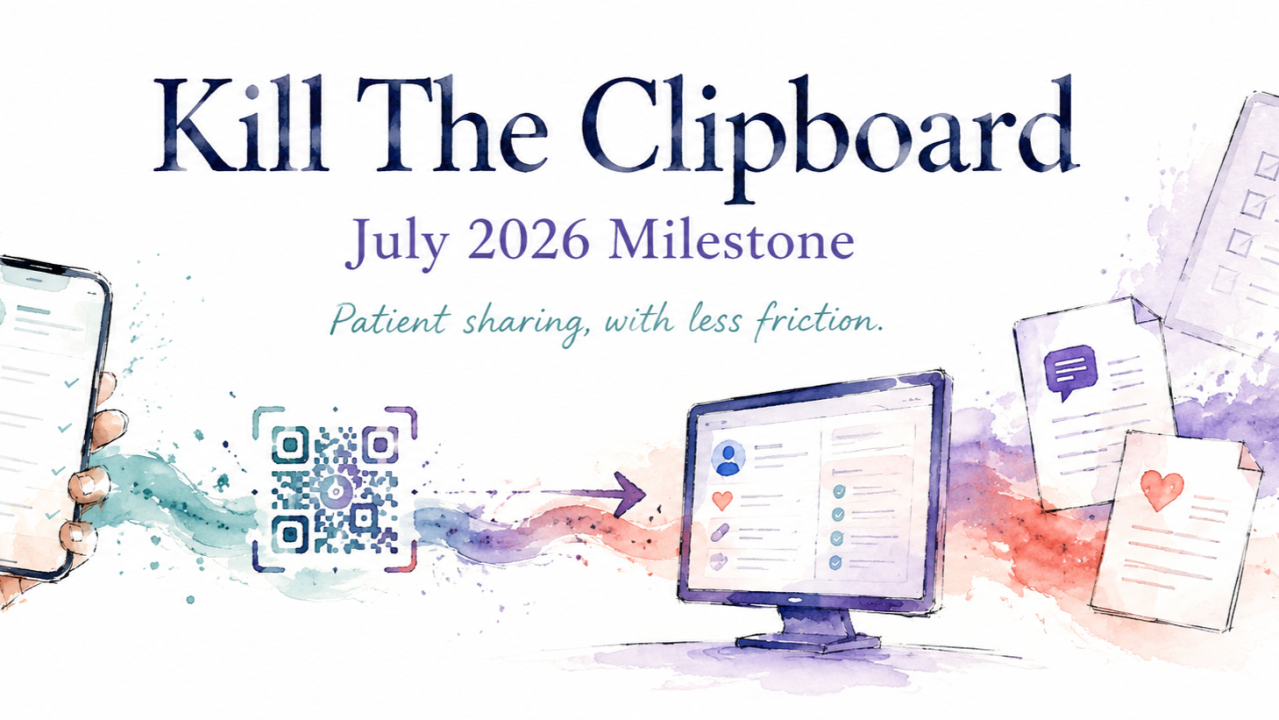
After discussion with Dave deBronkart at the Health Level Seven International working group meeting cookie break, I realized our KTC Spec is great for developers but not really accessible for patients, clinicians, and other stakeholders. There’s lots of work on more public materials, but I thought it’d be worth a quick update / explainer here.

Intake at a doctor’s office still looks different in every clinic. Some hand you a paper clipboard. Some email you a portal link the week before. Some pass you a tablet at the front desk, or text you a check-in link that opens on your phone in the waiting room. A specialty visit can hit you with several of these in sequence. The common frustration is that almost every clinic asks for the same information about your medications, allergies, problems, and immunizations — and almost none of them can get that information from anywhere except you, typed in fresh every time.

“Kill The Clipboard” is a long-term community, standards, and implementation effort to fix this! The idea is that patients should be able to share health information from an app they already use — the way you might show a boarding pass at the airport — so that clinics receive it without you retyping it, and without you needing a portal account at the receiving clinic.
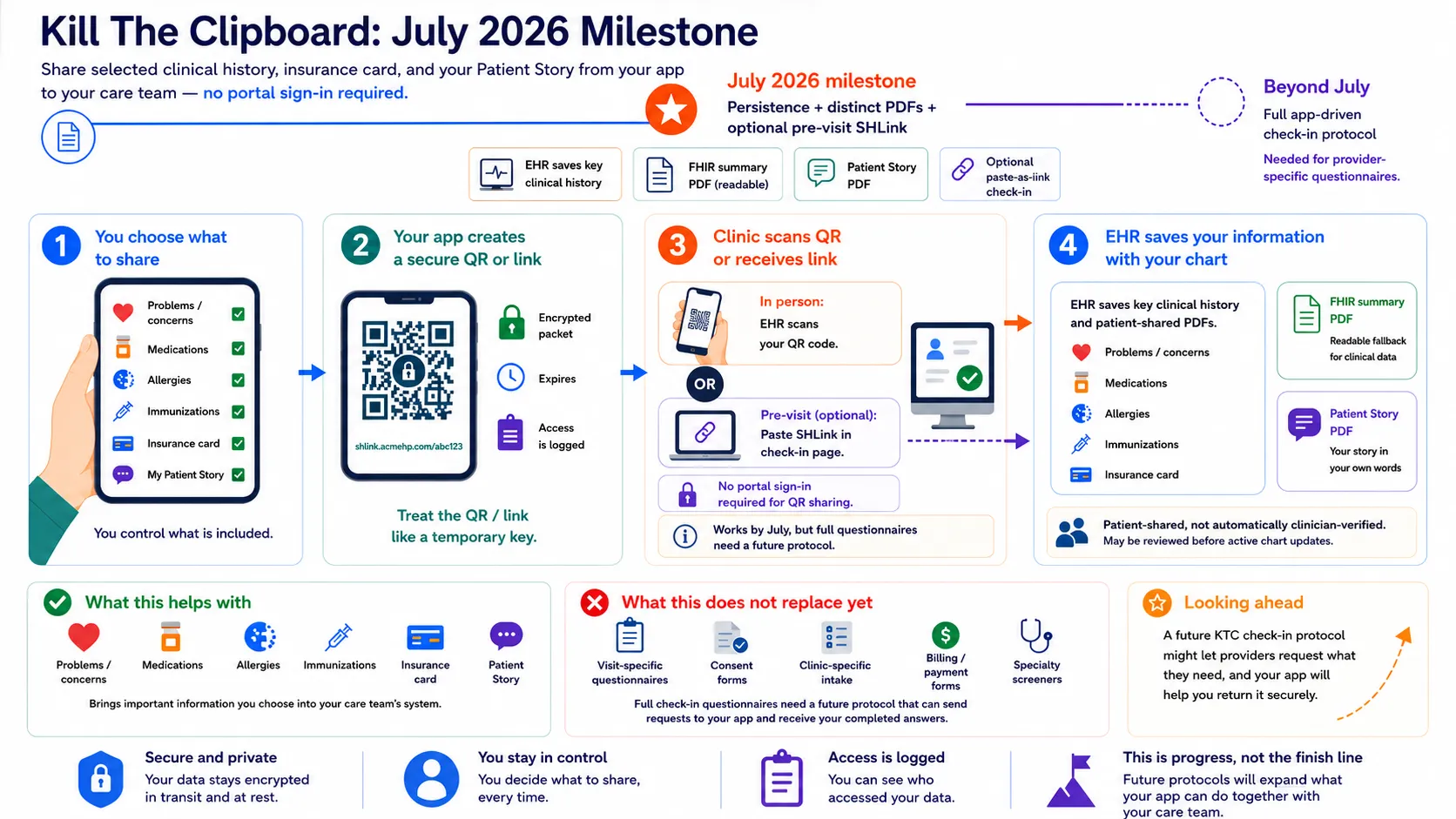
We’re making progress in stages, with the CMS Health Ecosystem helping to convene and shape this community work. As of April 2026, a clinic receiving a patient-shared PDF is required to keep it attached to the chart, with a label identifying it as something the patient provided. PDF contents are up to the patient — anything they want to send their care team.

As of July 2026, the same kind of requirement covers structured data. When you share your medications, allergies, active problems, or immunizations from your app as FHIR resources, the receiving EHR has to save this structured data into your chart. Why go deep with FHIR? A PDF often sits in the chart without connecting to anything else; a clinician typically has to open it, read it, and manually retype anything they want to use. (Of course: this is all changing with AI, but that is a topic for another discussion!) Structured data can appear in the same lists the clinic already looks at. Your shared allergies can sit alongside the clinic’s allergy list for review. Your shared medications can be checked against what the clinic already has on file.

The initial list of resources that an EHR must persist is short on purpose: the “PAMI” data set of problems, medication requests, allergies, and immunizations. The rest can grow from there, withe a goal that EHRs will eventually support persisting full clinical history using FHIR US Core. To enable a smooth transition, apps today are expected to include any FHIR US Core data the patient wishes to share; EHRs persist at least the FHIR PAMI content + PDFs, and will start importing more structured FHIR content as they’re ready.

What “saved in your chart” actually means

When you share a medication list, the clinic isn’t required to treat that as your verified medication list. In many workflows, a clinician will review what you sent before any of it moves onto the active list. The “shared by patient” label can stay attached until somebody verifies it.

How this looks will vary across EHRs; we’re not trying to standardize the clinician-facing UI paradigm. Some systems file the structured data directly into chart sections. Others keep the shared bundle as an attached document and surface its contents through a different view. Either way, the information stays attached to your record, properly labeled, and available to whoever opens the chart next.

Two kinds of PDF

A patient app can now provide two kinds of patient-shared PDF.

The first is a readable summary of the FHIR data you shared — a print-out of your med list, allergy list, and so on, generated automatically. It exists for systems and people that can’t easily work with the structured data directly. A backup view, in plain text.

The second is a Patient Story PDF: your own words. Not a rote summary of clinical facts (those are in the structured data) but the things the structured data can’t capture. What you’re most worried about. Something in your record you believe is wrong and want corrected. Context that explains what’s going on for you. Something like:

My biggest concern is that I’d like the care team to know that fatigue is affecting my daily life more than pain.

Patient advocates have argued for years that there should be a place in the chart for the patient’s own narrative, distinct from a clinician’s note about the patient. The July requirements make the Patient Story PDF its own artifact type, and the receiving EHR has to keep it.

Sharing before the visit

The main way this works is in person: you arrive at check-in, you show a QR code from your app, the clinic scans it. There’s also an option for sharing ahead of time. If a clinic’s online check-in page includes a field for a SMART Health Link (the technical name for the secure link your app generates), you can paste that link before your visit and the clinic gets everything in advance.

The mechanics are awkward. You leave the check-in page, switch to your health app, decide what to share, generate a link, copy it, switch back, paste it. The clinic also can’t tell your app what they need for this particular visit — you’re guessing at what’s relevant, and they’re taking whatever shows up.

What the new requirements don’t change

The new requirements cover the questions that get repeated at every visit: your medications, allergies, problems, immunizations, insurance, and the context you want your care team to understand. A meaningful slice of the clipboard.

But we have a long way to go! Visit-specific questionnaires. Reason-for-visit questions. Social-needs questions a particular clinic chose to ask. These exist because a specific clinic, on a specific day, needs a specific answer from you. The current setup has no interoperable way for the clinic to ask, and no way for your app to answer. So you’ll still fill those out.

What comes next

The piece that would finish the clipboard is a check-in protocol where the clinic can tell your app what it needs for this visit, and your app can answer back — questionnaires, specific data, etc — reviewed and approved by you, in an app you trust, on a device you own. The same protocol whether you’re doing it at home the night before, on the bus that morning, or scanning a QR code on the wall of the waiting room.

A working prototype exists: SMART Health Check-in, an open-source sketch where the clinic side asks for specific things — health records, questionnaires, insurance coverage — and the patient’s wallet app responds with the requested items plus a status for each (fulfilled, declined, partial). It runs in the browser, works on a phone or at a kiosk with handoff to the patient’s phone, and shows what a future check-in protocol could look like. It’s a prototype, not a standard, but it makes the shape of what comes next concrete enough to argue about.

The progression so far: as of April, your shared documents have a place in the chart. As of July, your shared structured PAMI data does too. Each step expands what patients can move themselves and what clinics are required to retain. For a full check-in protocol, we’ll need to keep pushing.
Conversation on LinkedIn

21 comments · 73 reactionsReply on LinkedIn
  • Mark SavageMay 18, 2026

    Managing Director, Digital Health Strategy & Policy ▪ Savage & Savage LLC ▪ San Francisco, California ▪ Washington, D.C.

    Thank you, Josh!

    2 reactions

  • Ralph Martello, MDMay 18, 2026

    Healthcare Innovator

    everyone should learn how to use claude code

    2 reactions

  • Dave deBronkartMay 19, 2026

    "e-Patient Dave" - Patient Empowerment evangelist. #PatientsUseAI. No pitches please.

    Josh, I'm so grateful for how clearly you've spelled all this out - and it was posted not long after our chat! You're really amazing.

    Is it too early to propose creating a simple short video showing someone doing it? This could get immense public support if people could just SEE it, I think.

    4 reactions

    • Josh Mandel, MDAuthorMay 19, 2026

      Dave deBronkart I think the April demo day at CMS included many illustrations of just this. I can't see anywhere that CMS has posted all the demos that were shown in-person in April... but this would be really helpful (hint hint, Zac Jiwa)!

      In the meantime, maybe not quite the real-world patient examples you're asking for but searching youtube finds https://www.youtube.com/watch?v=y9DOZrYOe-U https://www.youtube.com/watch?v=UW07ZU6mzds https://www.youtube.com/watch?v=4kO2JfLQ_zU

      1 reaction

    • Dave deBronkartMay 19, 2026

      "e-Patient Dave" - Patient Empowerment evangelist. #PatientsUseAI. No pitches please.

      Josh Mandel, MD Yes, those videos exist but as far as I know there's no umbrella "What this is" info like you've created here. Thanks for the specific example link, as a convenience for others.

      It's always worried me that KTC has had SUCH a flurry of activity in the back room, yet nearly zero effort to engage the public whom it's intended to serve.

      1 reaction

    • Dave deBronkartMay 19, 2026

      "e-Patient Dave" - Patient Empowerment evangelist. #PatientsUseAI. No pitches please.

      Note, btw, that the weekly calls have shown *significant* gaps in what THOSE ON THE CALL believe the project to be about. So I'm certain what you've done here will be appreciated by them, too.p.s. When you have the time, please do change that cover image to say "checkin" instead of sharing! :)

  • Dave deBronkartMay 19, 2026

    "e-Patient Dave" - Patient Empowerment evangelist. #PatientsUseAI. No pitches please.

    Personally, I don't mind if my QR code feeds all my basics into the system (including PAMI and even my full history) while I still have a few items to answer about THis visit! What people hate, in my experience, is being forced to constantly re-enter stuff that is in 8 billion computers about me, in fact it's everywhere EXCEPT healthcare.

    So I envision walking up with my QR and saying "Here's me" ["bleep! got it"], and now here's why I'm here (the non-standardized-yet questionnaire questions.

    10 reactions

    • Josh Mandel, MDAuthorMay 19, 2026

      Dave deBronkart Agreed there's real incremental value in sharing clinical history! That said, beyond July I think we need to zoom out and think about the overall UX for ahead-of-time check-in, because even for just the basics, switching back and forth manually between apps is going to be a showstopper for a lot of users.

      2 reactions

    • Dave deBronkartMay 19, 2026

      "e-Patient Dave" - Patient Empowerment evangelist. #PatientsUseAI. No pitches please.

      Josh Mandel, MD Fair enough. I have been strongly focused on CMS's strong push to declare it DONE at end of June (which long ago became "maybe July 4 ha ha for America 250" which has now become "July").You may recall that on the May 8 call Amy said this version (June) IS it for KTC, not a stopover. But of course I don't mind if it gets extended!

      1 reaction

    • Josh Mandel, MDAuthorMay 19, 2026

      Dave deBronkart Right -- realistically the timeframes for 2026 are "take what already exists and make it work," but the full ambition of KTC requires new capabilities, too.

      1 reaction

    • Dave deBronkartMay 19, 2026

      "e-Patient Dave" - Patient Empowerment evangelist. #PatientsUseAI. No pitches please.

      I'm just not sure who curates "the full ambition"! You and I have LONG wanted healthcare to get modern on such things - I just haven't been at all clear that the current "CMS tech ecosystem" work *has* a specific ambition :-), much less a well defined one.

  • Dave deBronkartMay 19, 2026

    "e-Patient Dave" - Patient Empowerment evangelist. #PatientsUseAI. No pitches please.

    Who created that superb "2026 milestone" graphic? I don't recall it being discussed in the Slack or anywhere, and its provenance isn't noted.

    In your cover image, it seems like the point would be infinitely clearer if it said "Patient checkin" instead of "Patient sharing."

    • Josh Mandel, MDAuthorMay 19, 2026

      This image was generated by ChatGPT, based on the spec + my guidance + several rounds of feedback from me + Claude. For anyone interested in how the sausage was made: https://chatgpt.com/share/6a0c24a9-8770-83ea-b002-26a23ad443de captures the main prompt flows (though I had a parallel conversation with Claude to turn the docs into a better blog post.. and then rounds of hand-editing).

      1 reaction

  • John ScullyMay 19, 2026

    Decentralized Medical Records System. Blockchain-based system, US patent 12266430

    Nothing has harmed our medical care system more than the EHR mandate.

    The emotional burden placed on physicians is so significant that, since 2008, the average retirement age for doctors has dropped by 9 years.

    We urgently need to transition from EHRs to a decentralized system, a move championed by @realDonaldTrump in 2019.

  • Rohan PintoMay 20, 2026

    Ξ CTO / Founder / 1Kosmos / Security Architect / Blockchain / Identity Management Maven / Cryptography Geek / Investor / Author

    Making the spec more accessible to patients and clinicians should help everyone understand how their data gets shared. It is a practical step toward broader adoption.

  • Tommy Di ZazzoMay 21, 2026

    Co-Founder @ BulkSched · Automating medical appointment scheduling inside Epic · Building for CIUSSS du Québec and provincial health systems across Canada

    July 2026 as a hard deadline — interesting. On the scheduling side of care, we're seeing the same friction: CIUSSS admin teams still juggling between Epic and Excel because native tools don't speak batch. That's exactly what we're building BulkSched around — SMART on FHIR, launched from Hyperspace. The clipboard is usually just a symptom of a workflow that has no native surface in Epic.

    1 reaction

  • Jim HansenMay 21, 2026

    Information Practitioner and Population Health Solutionist

    First the clipboard, then onward to KTF 'kill the fax' (machine)! 😀

    1 reaction

    • Josh Mandel, MDAuthorMay 21, 2026

      I believe "ax the fax" is the term of art!

  • Healthcare Marketing Leader

    Thank you, this is very informative.

  • Gary MeyerMay 27, 2026

    Health Tech Strategy & Decision Architecture | AI & Interoperability at Scale | Bridging Healthcare & Technology

    This is a great step forward—especially moving from PDFs to structured data that can actually show up in workflow.

    You can already see the next layer in how you describe it:
    share → persist → review → then decide what becomes “active.”

    The data is finally getting to the right place,
    but the criteria that determine what happens next still live somewhere else.

    Curious how you see that evolving—so the same information that reduces intake friction can also reduce the downstream back-and-forth that happens after submission.

  • Mary Jane BogackiMay 31, 2026

    Certified Coding Specialist (CCS)

    I suspect that outdated patient bios in neglected health apps would cause a lot of workflow disruption and eventually cause providers to sideline patient provided documents. However, provider-generated requests for specific data, prior to a visit, would allow a patient to consider and consent ahead of time.
    The health history data is the most likely to be objective and up to date, and (as soon as/as long as other providers scrutinize their documentation for scribe hallucinations) then interoperability continues to be the bottleneck.