I love Hugo's work here -- and it provides an important cautionary tale for any…
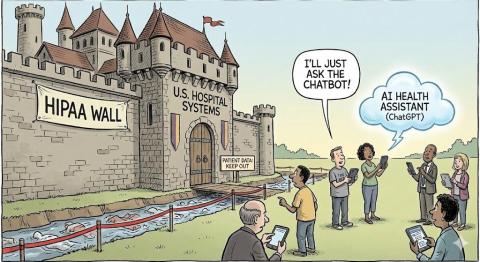
Original post on LinkedInI love Hugo’s work here — and it provides an important cautionary tale for any organizations trying to “protect” data through limited or locked-down APIs. If building connectors the “right way” (as I do with “Health Skillz”, ensuring that I, as the app developer, never have access to a patient’s data, and leaning on standards-based APIs like SMART on FHIR) leads to dead ends (as Hugo encountered with the Epic deployment at Kaiser Permanente of Northern California), patients will find their own workarounds by writing more… creative connectors that look just like end-users to the underlying system. AI agents make this increasingly easy. If EHR developers and provider organizations only offer options that are broken or worse than “roll your own agent,” it is a predictable outcome that everyone will roll their own agent.
Hugo Campos (original on LinkedIn):
I use Josh Mandel, MD MD’s SMART on FHIR Health Skillz to help manage my dad’s care. It’s a fantastic tool. It works great for that. It doesn’t work for my own care.
I’m a Kaiser member, and Kaiser’s FHIR API has a CORS misconfiguration that blocks browser-based patient tools. We wrote a four-page technical report documenting the issue, including a concrete gateway configuration fix. I sent it to Kaiser. Nothing changed.
So I built my own.
I don’t code Python. I had never written a Python program. What I did was direct Claude Code to build the tool I needed: an MCP server that bridges my Kaiser record into Claude Desktop, running on my laptop, under my own credentials. Claude wrote every line of code. I directed the work, tested it against my real account, made the design calls, and kept pushing until the tool worked. After a few weeks of evenings, OpenKP existed.
It’s public on GitHub. MIT-licensed, Kaiser Permanente Northern California only. Personal research tool, not a clinical product.
What’s new here isn’t just OpenKP. What’s new is that I built it: a patient who couldn’t have written it himself a year ago, working with an AI that could.
This is what patient-directed AI actually looks like. Not the AI your hospital deployed at you. Not even the patient-facing AI a developer built for you. The AI 𝙮𝙤𝙪 direct, on the data 𝙮𝙤𝙪 have a right to access, building the tool 𝙮𝙤𝙪 need.
A new generation of AI coding agents (Claude Code, OpenAI Codex, and others) has put solution-building in the hands of regular people. When the institutions serving us won’t fix what’s broken, we used to have to wait. Now we don’t.
That’s the change worth talking about.
Laura Adams Susan Brown Sheridan Amy Gleason Dave deBronkart Gilles Frydman Steve Labkoff, MD Ida Sim Grace Cordovano, PhD, BCPA Daniel Wolfe Nick Dawson